
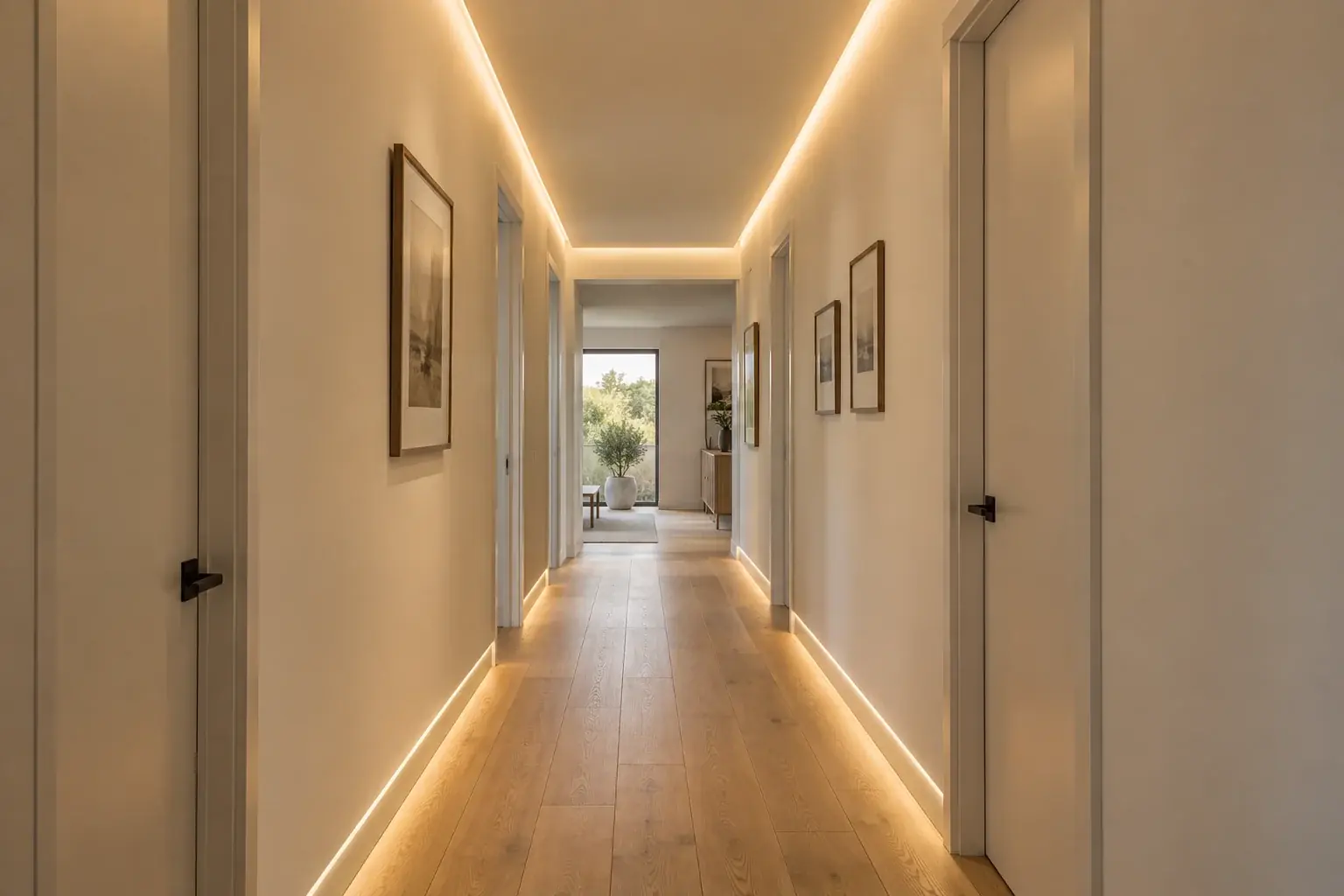
Keep the glow. Hide the source.
Cove lighting tucks the light source behind a ledge or inside a recess, allowing light to reflect across the ceiling. The result is softer than looking directly at a bright strip. It can make a room feel comfortable at night without asking every overhead light to be on.
The cove is part of the architecture. Its depth, finish and sightline affect whether the result is a smooth wash or a row of visible dots. A product sample and a small mockup are useful before finishing the whole room.
Plan around how you use the room.
In a bedroom, you might want a low evening setting and a separate bedside light. In a living room, the cove can provide atmosphere while lamps or downlights serve reading and other tasks. It should not be assumed to replace every other light.
Color temperature and dimming are separate choices. Choose the color of the light against your actual walls and furniture, then test how far the selected system dims without distracting behavior.
Cove lighting in Iowa City, Coralville, North Liberty and Cedar Rapids.
Cove lighting is one of the few ceiling details where the age of the house changes the conversation more than the size of the room. The questions below are the ones worth answering before anyone quotes a cove, and they are the reason a cove in a 1920s house near downtown Iowa City is not the same job as a cove in a 2015 build in North Liberty.
Older homes, including much of the housing near the University of Iowa campus and in the older Cedar Rapids neighborhoods, often have plaster rather than drywall, ceiling heights that vary across a single room, and wiring that has been added to over decades. None of that rules out a cove. It does mean the perimeter has to be measured rather than assumed, and that the electrical route matters as much as the detail itself.
Newer construction in Coralville and North Liberty tends to bring the opposite set of questions: flat eight or nine foot ceilings, engineered trusses, and a mechanical layout that is easier to read but less forgiving about where a soffit can land. A cove often works well here, provided the depth is chosen so the room does not feel shorter than it is.
We confirm the ceiling, the perimeter and the electrical access on site before any of this is priced. Tell us the town and the room and we will tell you which of these questions applies to you.
- Plaster or drywall, and whether the existing surface is sound enough to carry a new detail
- Actual ceiling height at several points, not just one measurement
- Where the power supply can live and still be reachable for service
- Whether a soffit or trusses restrict the perimeter you want to light
- In a condo or rental, who has to approve the work before it is scoped
Think beyond the LED strip.
Ask about compatible controls, the location of the power supply, and how components will be reached for service. Concealing the light should not mean permanently hiding equipment that may need maintenance. Electrical planning belongs with the qualified installer.
A good scope explains the cove construction, lighting product, switching, finishing and whether existing wall or ceiling surfaces need repair. That makes proposals easier to compare.
- Direct sightlines checked from standing and seated positions
- A lighting sample checked against the room finishes
- Controls and component access agreed before finishing
- A clear distinction between decorative and task lighting
The detail in section.
A cove is a small piece of construction before it is a lighting product. Seen from the side, it is a ledge, a return that hides the source, and a gap that decides how the light spreads.
- LED channel and diffuser. Sits on the ledge facing up. The diffuser is what turns a row of diodes into a continuous line.
- Drywall return. Rises above the channel so that no one standing or seated in the room sees the source itself.
- The gap. Distance to the ceiling, together with the depth of the ledge, sets how far the light spreads and how bright the band directly above the cove looks.
- Driver and controls. Concealing the light should not mean sealing in the equipment. The driver needs a location that can be reached again.
Questions worth asking.
Will I see individual LED dots?
That depends on the product, placement, diffuser and viewing angle. Ask to see a sample in a comparable detail before approving it.
Can cove lighting be dimmed?
Many systems can, but the strip, driver and dimming control must be compatible. Confirm the exact combination and test its behavior.
Can I add it without rebuilding the whole ceiling?
Sometimes. An existing tray or a suitable new perimeter detail may accommodate it. The available space and electrical access determine the options.