
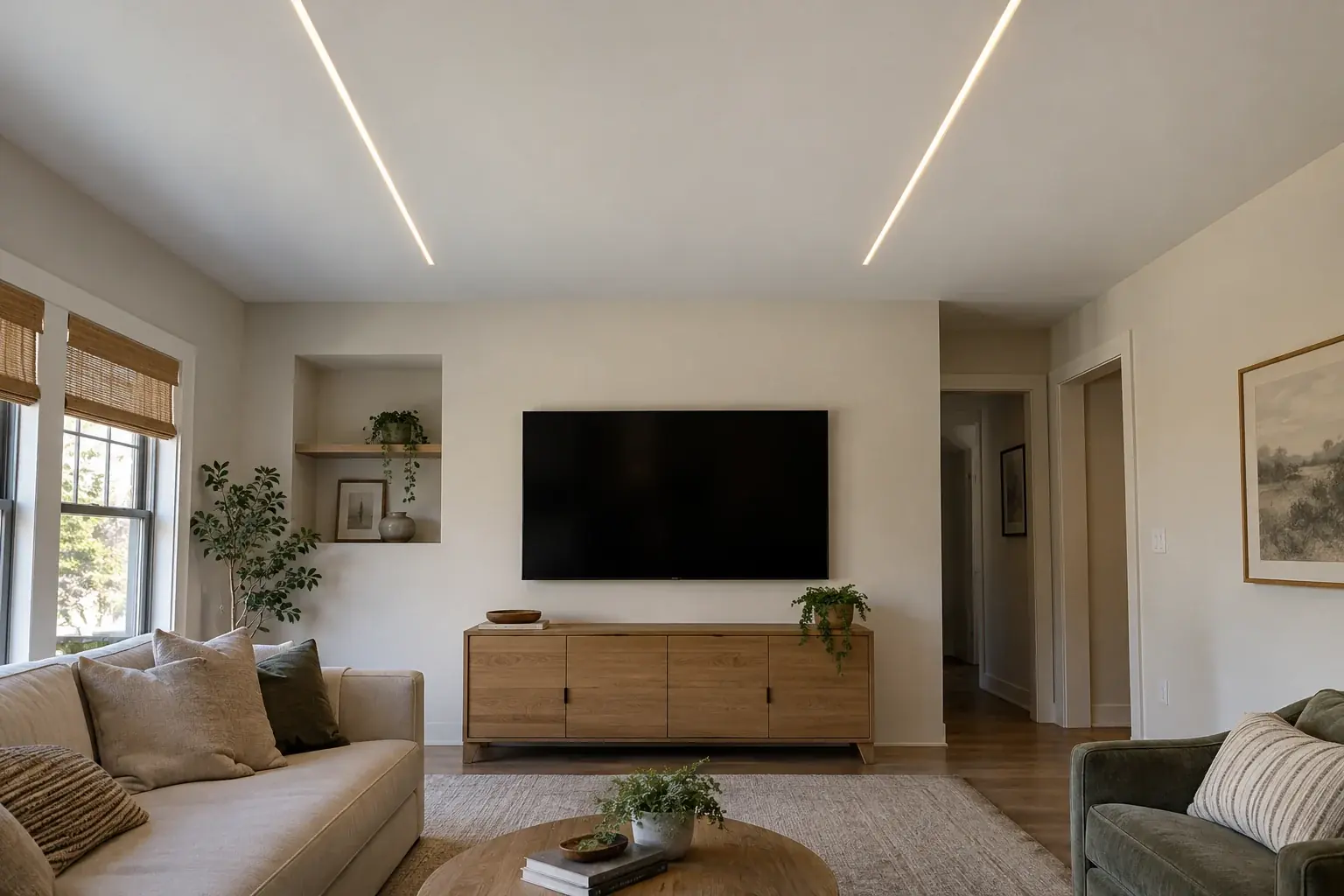
A line of light, without a bulky fixture.
Recessed linear lighting places a narrow light channel into the ceiling. Plaster-in or mud-in systems allow the surrounding finish to meet the channel with little or no visible trim. The look is sharper than indirect cove lighting because you see the illuminated line itself.
Two carefully placed lines can be more convincing than a ceiling covered in intersections. Start with what the room needs: a route through the space, a defined seating area or an even lighting pattern.
The ceiling and the light need one plan.
Channel locations should be coordinated with the ceiling assembly and services before work begins. A drawn line on an inspiration photo does not establish that a fixture will fit in the same place in your home.
Ask to see the chosen product when lit and unlit. The visible lens, its width, how corners meet and the surrounding paint finish all affect the result. Also consider reflections on a TV screen and the view when you lean back in a chair.
Small details are easy to notice.
Long straight lines put the workmanship on display. The scope should identify the actual channel and compatible lighting components, its placement, finish treatment, controls and maintenance access.
It is worth simplifying the layout before sacrificing the finish. More intersections mean more decisions and more opportunities for a small mismatch to become visible.
- Fixture depth and ceiling conditions checked together
- Layout coordinated with furniture and existing services
- Diffuser appearance and glare discussed before purchase
- Compatible controls and service access included
Questions worth asking.
Is this the same as sticking an LED strip on the ceiling?
No. Recessed systems use channels integrated into the ceiling assembly. The installation and finishing are part of the design.
Will it work in a finished ceiling?
Potentially, but opening, repairing and repainting the ceiling may be required. The scope depends on the system and existing construction.
Can we do geometric patterns?
Patterns are possible with suitable products and planning. Simple parallel lines or one restrained shape are a practical starting point.