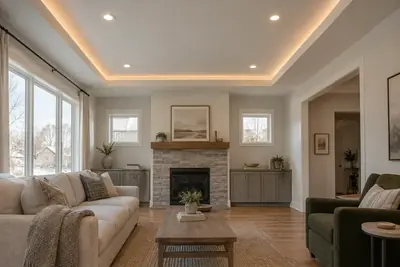
They solve different problems.
Cove lighting is useful when you want the ceiling to carry a soft wash of light. Downlights are useful when light needs to reach particular areas below. They can complement each other, but they should not be treated as interchangeable products.
Imagine a living room on a weekday evening. You may want low light while watching television, a brighter setting for tidying up and a reading lamp beside one chair. One switch controlling every light makes those moments harder to serve. Think in activities before you think in fixture counts.
Check the view from your chair.
A hidden light is only hidden if the detail works from the places you sit and stand. A strip that is invisible from the doorway may become visible when you recline. With downlights, the angle of the fixture and the placement relative to seating also affect comfort.
The best discussion uses the room itself. Identify the seating positions, TV screen, mirrors and glossy surfaces. Ask how the selected fixtures will appear from each position and whether a sample can demonstrate the proposed cove detail.
Color and brightness are separate choices.
Turning a light down changes its brightness. It does not necessarily change the color of the light in the same way an incandescent lamp would. Ask what the selected product actually does when dimmed instead of relying on a generic label such as “warm.”
Compare a sample against your walls and fabrics. A warm-looking photograph on a phone does not tell you how your paint will appear at home. If more than one light source is visible together, discuss how they will look as a group, not just as individual products.
Make the controls easy to live with.
Separate control of the cove and the main room lighting gives you choices. That does not mean every section needs an app or a complicated scene. A familiar wall control may be the easiest everyday option.
Have the installer confirm compatibility across the actual lighting components and controls. Ask how the system behaves at its lowest setting and how components can be reached later. The neatest-looking ceiling is less useful if a routine service task requires damaging the finish.
Start with a small lighting brief.
Write down three moments: arriving home, using the room for its main purpose, and winding down. Note what should be bright, what should feel calm and what should stay out of your eyes. That short list is more useful than requesting a fixed number of lights because a photo had that many.
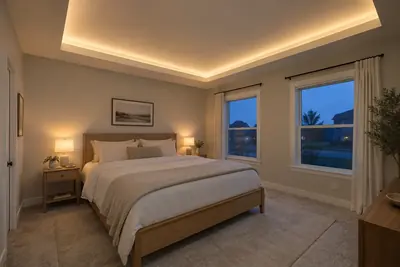
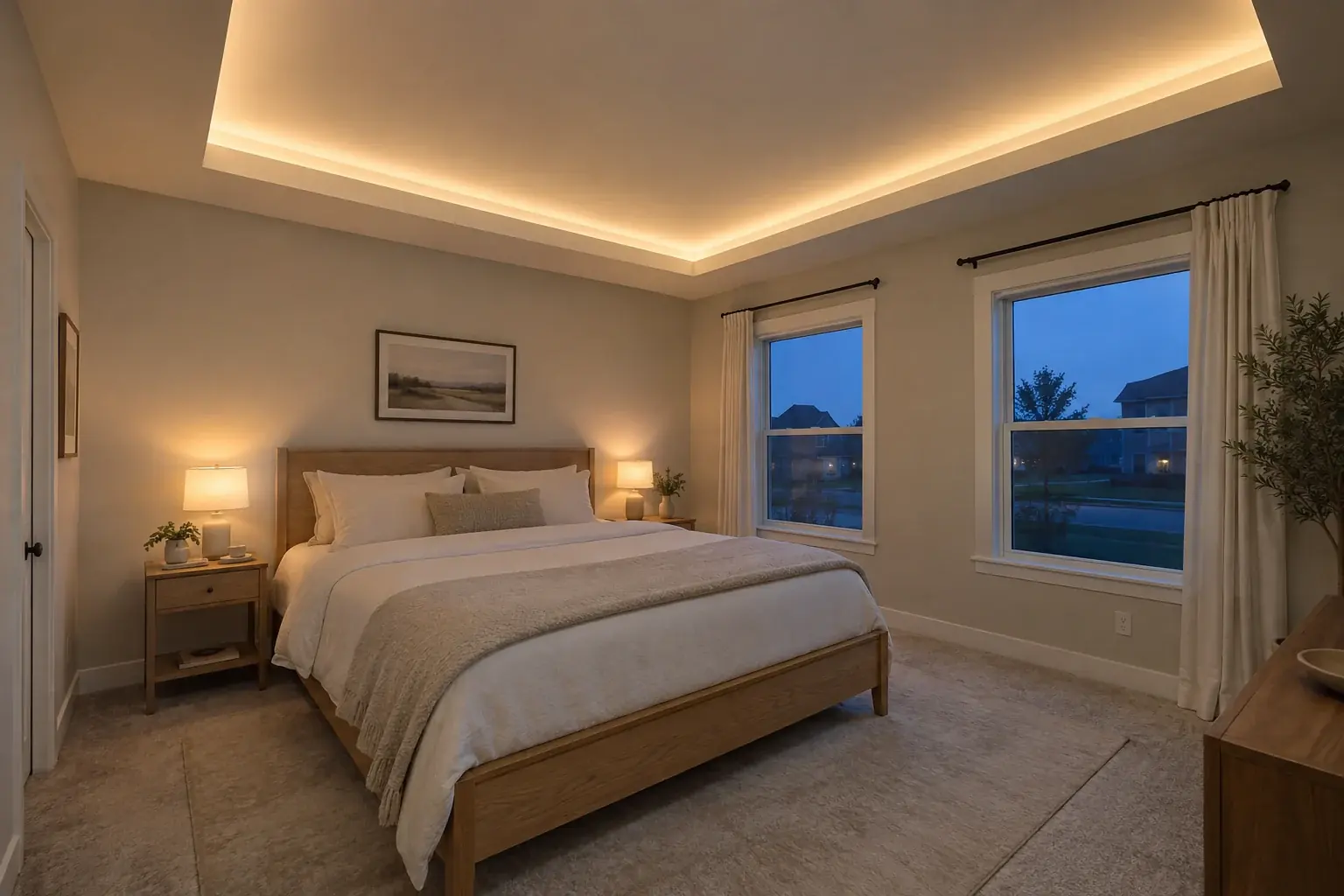
For the bedroom concept here, the perimeter glow illustrates an atmosphere, not a complete lighting calculation. Your room may also need bedside, task or general lighting. The final selection depends on dimensions, finishes and the performance of the chosen fixtures.
A few more questions.
Can cove lighting be the only light in a room?
It might be part of the general lighting, but do not assume it is sufficient. The room, reflective surfaces and product output need to be considered.
Do I need smart lighting?
No. Compatible wall dimming can be a straightforward option. Choose controls around how you use the room.
Why does a cove sometimes show bright dots?
The visible result depends on placement, optics, diffusion and the chosen LED product. Check the actual detail with a sample.
The next step.
Explore cove lighting in the Iowa City area, or request an estimate with your room details.
Further reading
These guides help you plan a conversation. They are not room-specific construction instructions or a substitute for an installer assessing your home. Images illustrate design ideas rather than completed Petra work.